
Organizational Knowledge
How to Turn Company Knowledge Into an Online Training Academy
Most organizations already own more educational material than they realize. The problem is that it is scattered, unstructured, and undiscoverable. Here is how to convert it into a working Academy.
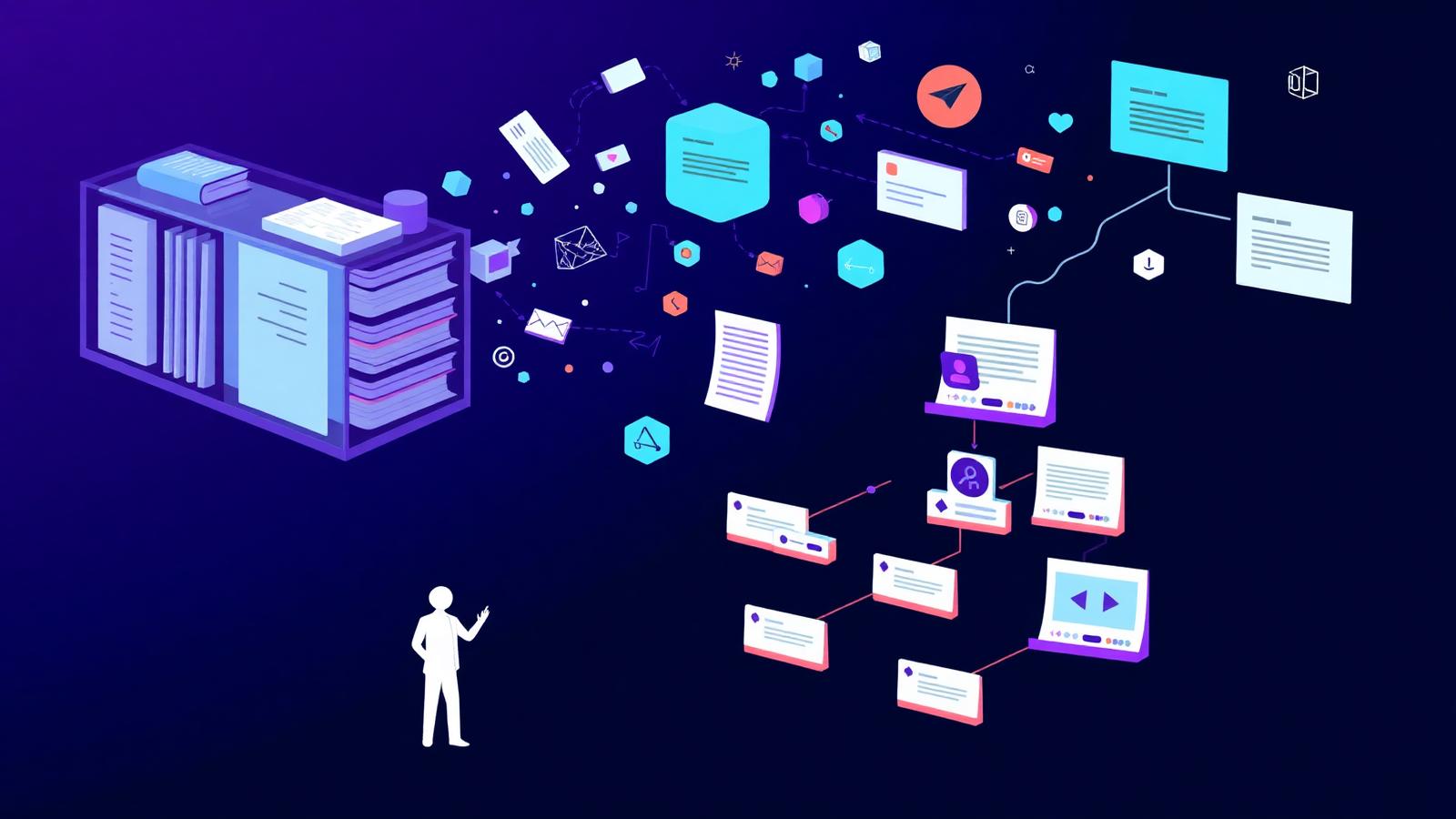
Turning company knowledge into an online training Academy is a conversion process with five stages: inventory what exists, decide what deserves to become education, restructure raw material into learning designed around outcomes, have subject-matter experts review it, and publish it into a maintained structure that stays current.
The reason this is worth doing is that most organizations already own the raw material for substantial education programs. It exists as training decks, standards documents, recorded webinars, process manuals, research, policies, and — most valuably and most fragilely — in the heads of experienced people. What is missing is not content. It is structure, sequence, and maintenance.
Start With a Knowledge Inventory
An inventory is a survey of what the organization already knows and where that knowledge currently lives. Do it before designing anything, because the inventory usually changes the plan.
Look systematically across the following categories.
Training materials. Existing internal courses, onboarding decks, workshop content, facilitator guides, job aids. Often the largest single source, and often duplicated across departments in inconsistent versions.
Standards and frameworks. Technical standards, methodologies, quality frameworks, regulatory interpretations. Frequently the organization's most differentiated knowledge, and typically written as reference documents rather than teaching material.
Research and analysis. Internal studies, white papers, market analysis, technical reports, published findings.
Policies and procedures. Compliance requirements, operating procedures, safety guidance, governance documentation. Usually mandatory to communicate and rarely taught well.
Presentations. Conference talks, internal briefings, client presentations, all-hands decks. Rich in expert framing, weak in standalone comprehensibility.
Recordings. Webinars, recorded sessions, expert interviews, meeting captures, podcast episodes. High-value, almost always undiscoverable, and rarely watched a second time.
Existing courses. Anything already built in an LMS, including content that has drifted out of date.
Subject-matter expert knowledge. The unwritten reasoning, judgment, and pattern recognition held by experienced people. This is the highest-value and highest-risk category — it leaves when they do.
For each item, record what it covers, who owns it, how current it is, who the intended audience is, and its condition. That last field matters: a current, well-structured document and a five-year-old deck with no narrative require very different amounts of work.
Decide What Deserves to Become Education
Not all knowledge should become a course. Converting everything produces an unusable catalog and an unmaintainable maintenance burden.
Useful selection criteria:
- Audience demand. Does someone genuinely need to learn this? Frequency of the underlying question is a good proxy.
- Consequence of not knowing. Compliance, safety, quality, and customer impact raise priority.
- Differentiation. Knowledge unique to the organization is worth more as education than material available generically.
- Volatility. Content that changes monthly is a poor candidate for a polished course and a good candidate for a short reference module.
- Key-person risk. Knowledge held by one or two people who are approaching retirement or transition should be prioritized regardless of demand.
- Reusability. Material that serves multiple audiences — employees, customers, partners, members — justifies more investment.
The output of this stage is a prioritized conversion list, not a complete map of everything the organization knows.
A common and avoidable mistake: starting with the largest, most comprehensive body of material. Start instead with something high-demand, well-bounded, and clearly owned. The first conversion teaches the organization how to do the next twenty.
Convert Knowledge Into Structured Learning
This is the stage where source material becomes education, and it involves more than reformatting. Reference material is organized by topic; learning is organized by outcome.
The conversion sequence:
1. Define the learning outcome. What should someone be able to do after this that they could not do before? Written as capability, not coverage. "Understands the standard" is not an outcome. "Can determine which clause applies to a given scenario and justify it" is.
2. Identify the audience and their starting point. Prior knowledge, role, context, and constraints determine depth and terminology.
3. Design the structure before writing. Course, modules, lessons. Sequence from foundation to application. Sequencing is where most raw material fails — documents are rarely written in learning order.
4. Restructure the source material. Break dense reference content into teachable segments. Add the connective explanation experts omit because it is obvious to them.
5. Add explanation and examples. Reference documents state rules. Learning explains why the rule exists, what it looks like when applied, and what going wrong looks like. Examples are usually the missing ingredient.
6. Design practice and assessment. Exercises and scenarios that require applying the knowledge rather than recognizing it.
7. Add navigation and reference paths. People will return to find one specific thing. Design for that, not only for linear completion.
Format decisions should follow content type. Procedural knowledge suits step-by-step lessons with practice. Judgment-based knowledge suits scenarios and worked examples. Conceptual knowledge suits explanation with diagrams. Expert reasoning often works best as recorded conversation with structured supporting material.
Use AI to Accelerate Course Development
AI has changed the economics of this work substantially. The bottleneck in Academy development has always been production labor: restructuring documents, drafting lesson text, writing assessment items, producing translations, and updating content when the source changes.
Where AI assistance is genuinely effective:
- Restructuring long documents into proposed module and lesson outlines
- Drafting lesson narrative from source material, in a consistent voice
- Generating assessment items — scenarios, questions, distractors — from lesson content
- Summarizing recordings into structured written lessons with timestamps
- Extracting procedures, definitions, and requirements from dense reference documents
- Adapting the same content for different audiences and levels of prior knowledge
- Translating content for multilingual delivery
- Identifying gaps — where a lesson asserts something without explaining it
- Refreshing content when a source policy or standard is revised
What AI does not do is decide what is correct, what matters, or what the organization's position is. It accelerates production; it does not supply authority. Treating its output as a draft for expert review is the only defensible workflow.
Subject-Matter Expert Review Is Non-Negotiable
Expert review is what makes an Academy trustworthy. Without it, an organization publishes plausible content under its own brand — the worst possible outcome for institutional credibility.
Make review practical rather than heroic. Experts are busy, and asking them to write courses generally fails; asking them to review structured drafts generally succeeds.
An efficient review model:
- Expert interview or existing material provides the source
- Drafting produces a structured, complete first version
- Expert reviews for accuracy — correctness, completeness, nuance, and anything materially misleading
- Instructional revision addresses clarity and learning design
- Expert approves the final version
- Approval is recorded with a name and date
That record matters. Knowing who approved which version and when is what makes an Academy auditable and maintainable.
Establish Governance
Governance is what prevents an Academy from becoming a graveyard of stale content within two years.
The minimum viable governance model defines:
- Content ownership. Every course has a named owner accountable for accuracy.
- Review cadence. How often each course is revisited. Regulated content typically annually or on change; volatile content more often.
- Change triggers. Which upstream events — a policy revision, a standard update, a process change — require content review.
- Approval authority. Who can approve publication, particularly for compliance-relevant material.
- Version control. What version a learner completed, and whether a change requires re-completion.
- Retirement policy. How obsolete content is removed rather than left to mislead.
- Access and permissions. Who sees what, particularly when the Academy serves external audiences.
| Content type | Typical review cadence | Trigger-based review |
|---|---|---|
| Compliance and regulatory | Annual | Any regulatory change |
| Standards and methodology | Annual | Standard revision |
| Process and procedure | Semi-annual | Process change |
| Tool and technology | Quarterly | Version or vendor change |
| Foundational concepts | Every 2 years | Rarely |
Publish Into a Real Learning Experience
Publishing is not uploading. A collection of files is not an Academy, and the difference determines whether people use it.
What learners need to encounter:
- A coherent catalog with categories that reflect how they think about their work
- Pathways that sequence courses toward a defined capability, not a flat list
- Discoverability — search and navigation good enough to answer a specific question in under a minute
- Progress tracking so learners can resume rather than restart
- Assessment and, where appropriate, credentials
- Consistent branding so the Academy reads as an organizational asset rather than a tool
- Genuine mobile usability, because much of this is consumed in short intervals
Increasingly, learners also expect to ask questions and get answers in context. AI-supported instruction — where a learner can ask about the material and receive an answer grounded in the organization's own approved content — changes an Academy from something people complete into something they consult.
Maintain the Academy
Maintenance determines whether an Academy compounds in value or decays. Build the routine deliberately:
- Run scheduled reviews on the defined cadence and treat missed reviews as a real issue
- Monitor learner questions and search terms; unanswered questions are the content roadmap
- Update content when upstream sources change, not at the next annual cycle
- Capture new institutional knowledge continuously, particularly before people transition out
- Retire obsolete content promptly
- Track which content is used and which is not, and act on it
- Expand deliberately, adding pathways and audiences as the structure proves stable
Where Organizations Get Stuck
Four recurring failure patterns, all avoidable:
Uploading instead of converting. Documents become downloads rather than learning. Learners get a file library and no capability.
Scope that outruns capacity. Attempting to convert everything at once produces an unfinished catalog and organizational fatigue. Sequence by priority.
Expert-authored content. Experts asked to build courses do not have time and are usually not instructional designers. Draft first, then have them review.
No maintenance model. The most common eventual failure. Content that was accurate at launch becomes actively misleading, and learners stop trusting the Academy entirely.
The organizations that succeed treat their Academy as infrastructure rather than a project — something owned, funded, measured, and maintained. What they get in return is institutional knowledge that no longer walks out the door, education their audiences actually use, and the ability to teach at a scale that scheduled training never reaches.