
AI Strategy
Are Your Procurement Professionals Prepared to Buy AI and Emerging Technologies?
Are Your Procurement Professionals Prepared to Buy AI and Emerging Technologies?
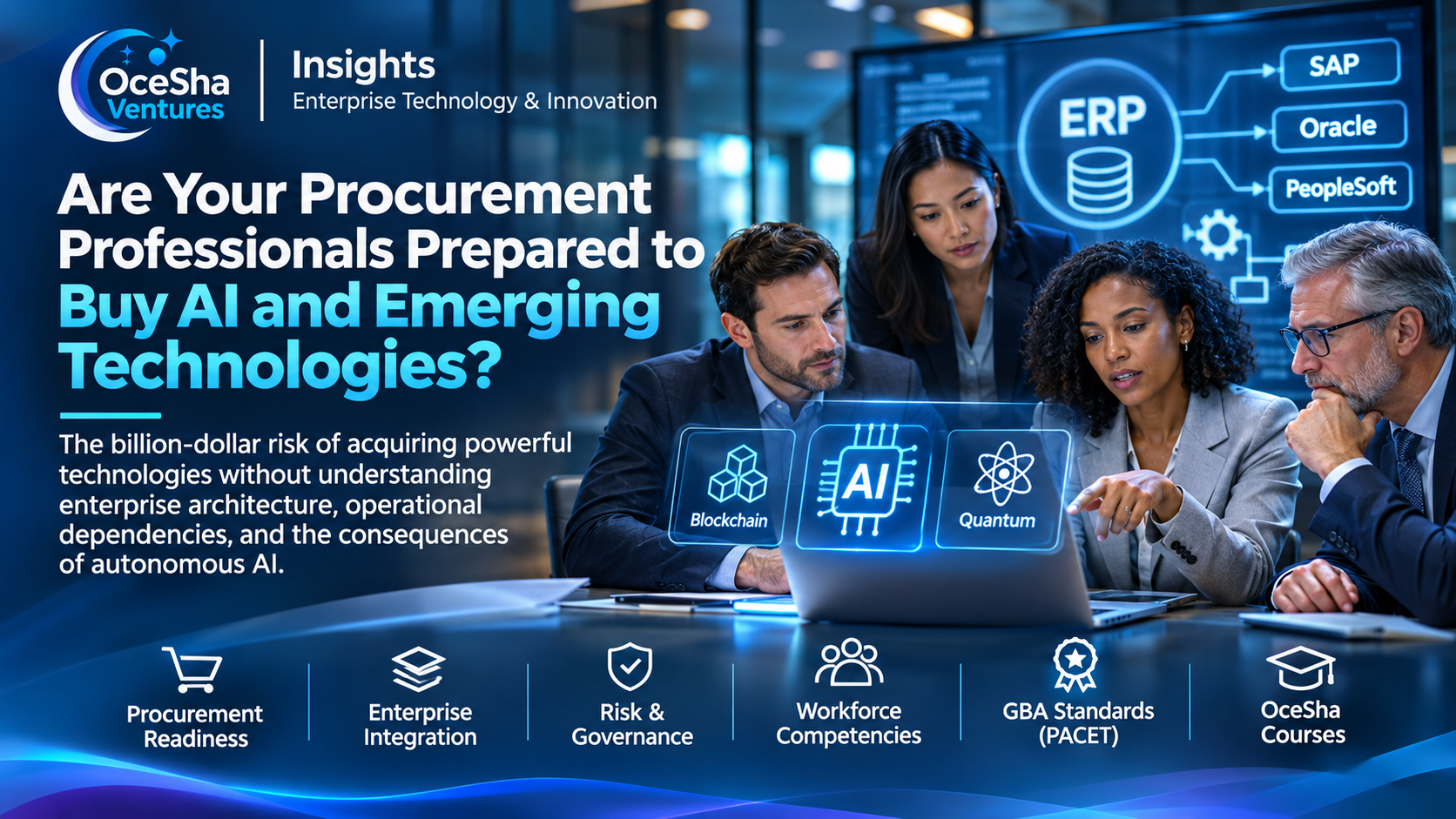
Are Your Procurement Professionals Prepared to Buy AI and Emerging Technologies?
The billion-dollar risk of acquiring powerful technologies without understanding enterprise architecture, operational dependencies, and the consequences of autonomous AI.
By Rohan Hall Founder & CEO, OceSha Ventures Member, Government Blockchain Association (GBA) Participant, GBA–IT-AAC Emerging Technology Acquisition Standards Working Group
OceSha Ventures Insights | November 2026
---
The Next Billion-Dollar Technology Mistake May Begin in Procurement
Artificial intelligence is transforming the enterprise at an extraordinary pace. Organizations are deploying AI to improve productivity, accelerate decision-making, automate business processes, and create entirely new capabilities.
Agentic AI is taking this transformation further by introducing systems that can independently plan, make decisions, use tools, and execute complex tasks.
These developments present enormous opportunities.
But they also raise an important question that I believe enterprise leaders are not discussing nearly enough:
Are the professionals responsible for purchasing these technologies sufficiently prepared to understand what they are bringing into their organizations?
Consider a multinational enterprise operating SAP, Oracle, PeopleSoft, or another enterprise resource planning (ERP) platform.
The organization purchases an AI solution that promises to automate procurement operations, streamline financial processes, and reduce administrative costs. The vendor demonstrates an impressive system that can understand instructions, navigate applications, and update enterprise information.
The procurement team evaluates functionality, pricing, implementation timelines, security documentation, and contractual terms. The technology receives approval.
But what happens if the AI system is authorized to modify enterprise records without understanding the business rules, transaction dependencies, and cross-functional controls built into the organization's ERP environment?
What happens when an AI agent successfully changes a database field but fails to execute the business processes that should accompany that change?
The immediate operation might appear successful. The broader enterprise consequences may not become visible until much later.
An incorrectly processed transaction could affect purchasing approvals, financial reporting, inventory availability, supplier payments, compliance obligations, or other dependent business processes.
In a sufficiently complex organization, the resulting disruption could become extraordinarily expensive.
This is what I call the potential billion-dollar enterprise AI mistake.
Not because a billion-dollar AI-agent ERP failure has been established, but because the scale of exposure in a major enterprise can extend far beyond the individual transaction.
The critical issue is not whether AI can perform a task.
It is whether the AI can perform that task while preserving the integrity of the enterprise.
A Perspective Grounded in Enterprise Technology
My concern about this issue comes from practical experience, not opposition to artificial intelligence.
For more than three decades, I have worked in enterprise technology, software architecture, and business transformation.
For 12 years, I operated an ERP consulting firm serving major organizations, including HP, Corning, Sierra Pacific Resources, and American Honda Finance Corporation.
My experience includes PeopleSoft enterprise applications, enterprise education deployments, Oracle database initiatives, and projects involving complex business systems and organizational workflows. I have also collaborated on enterprise projects with major consulting organizations, including Accenture, KPMG, and Deloitte & Touche.
Working with these environments provides an appreciation for something that can be difficult to understand from the outside.
Enterprise software is not simply a collection of screens, database tables, and APIs.
It is an interconnected system of business rules, authorizations, transaction controls, organizational dependencies, financial responsibilities, and operational processes.
A seemingly minor change in one part of an ERP system can have implications across multiple departments.
Today, as founder and CEO of OceSha Ventures, I develop AI-native enterprise technologies designed to make complex business processes more efficient, intelligent, and scalable.
I am also a member of the Government Blockchain Association (GBA) and actively participate in the working group developing emerging-technology acquisition standards and professional competencies through the collaborative initiative involving GBA and the Information Technology Acquisition Advisory Council (IT-AAC).
This combination of enterprise architecture experience, AI technology development, and participation in acquisition standards work has reinforced an important principle:
Enterprise AI innovation must be accompanied by enterprise architectural discipline—and procurement professionals must understand enough about both to make informed acquisition decisions.
AI-Native and Agentic AI: An Important Distinction
One of the first competencies procurement professionals need is the ability to distinguish between different AI architectures.
These terms are often used interchangeably, but they describe different characteristics of technology.
AI-Enabled Applications
An AI-enabled application is generally a conventional software system enhanced with artificial intelligence capabilities.
For example, a traditional procurement application might incorporate AI to summarize contracts, classify suppliers, or recommend purchasing categories.
The application retains its established architecture while adding AI capabilities to specific functions.
AI-Native Applications
An AI-native application is designed with artificial intelligence as a foundational part of its architecture and business functionality.
AI is not merely an added feature. It plays a central role in how the application delivers value.
An AI-native enterprise application might use AI to analyze organizational knowledge, generate structured content, evaluate documents, or produce business recommendations.
Importantly, an AI-native application can maintain deterministic workflow orchestration.
The enterprise can define the required inputs, execution stages, validation rules, permissions, approval checkpoints, output structures, and operational limits.
Although AI-generated content may vary, the application can enforce predictable business processes and acceptance criteria.
Agentic AI Applications
Agentic AI introduces a different dimension: autonomy.
Rather than following only a predefined sequence of actions, an AI agent can be given an objective and permitted to determine how to accomplish it.
Depending on its design and permissions, the agent may select tools, gather information, evaluate intermediate results, revise plans, and execute actions.
This can be extraordinarily valuable.
An agent might independently research supplier alternatives, identify contractual risks, investigate discrepancies, or prepare recommendations for procurement managers.
But there is a fundamental difference between an AI agent that analyzes information and one authorized to modify enterprise systems.
The critical enterprise question is not simply whether a system is agentic. It is what authority the system has, what controls govern that authority, and what consequences its actions can produce.
AI-native and agentic are not mutually exclusive. An AI-native application can incorporate agentic workflows while retaining deterministic controls over critical business transactions.
That distinction should be central to enterprise technology evaluations.
Why Predictability Is a Business Requirement
Enterprise organizations do not operate like independent consumer applications.
A consumer-facing AI service may generate a response that requires revision. A user can request another answer, correct the result, or restart the task.
The consequences are often limited to that individual interaction.
Enterprise systems operate within a different environment.
They support financial commitments, supplier relationships, customer orders, regulatory obligations, employee compensation, inventory management, and other critical operations.
An incorrect action may affect thousands of transactions, multiple business units, or external partners.
This is why enterprise systems have traditionally emphasized structured business processes.
Organizations need to know:
- What information is required before a transaction can proceed.
- Which employees or systems are authorized to perform specific actions.
- What business rules must be satisfied.
- Which approvals are required.
- What downstream processes are triggered.
- How transactions are recorded, audited, reconciled, and recovered.
- What the operational and financial consequences of failure might be.
Deterministic controls do not eliminate all risk, and AI-native applications can still produce inaccurate or inconsistent AI-generated outputs.
However, enforceable business rules and structured execution boundaries can substantially reduce uncertainty about what an application is permitted to do.
This is particularly important when the technology is operating within an integrated ERP environment.
The ERP Problem: Why Updating a Database Is Not the Same as Executing a Business Transaction
Consider a procurement officer working in SAP.
The officer opens a purchase order that has already been approved and changes a material commercial field.
To an inexperienced software developer, this might appear to be a straightforward database operation.
Find the purchase order. Update the relevant field. Save the record.
But enterprise systems do not necessarily work that way.
What SAP Actually Does
SAP S/4HANA includes configurable purchase-order approval workflows.
SAP's official documentation explains that changes to certain purchase-order fields can restart the approval process.
Depending on the product version and configuration, these fields can include:
- Company code
- Purchasing organization
- Purchasing group
- Currency
- Plant
- Material group
- Net order price or total net order value
- Order quantity
- Other purchasing attributes
The system evaluates these changes within its configured business workflow.
The precise behavior depends on the SAP implementation, but the architectural principle is consistent: the application processes business transactions according to rules that extend beyond simply storing new values.
Source: SAP Help Portal — Manage Workflows for Purchase Orders
An Illustrative $100,000 Purchase Order
Imagine an organization has approved a purchase order for $100,000.
An AI agent receives an instruction to update the order to $150,000 following a supplier price adjustment.
There are two fundamentally different ways this could occur.
Scenario A: The AI uses an authorized ERP business transaction.
The system processes the change through the appropriate SAP application or supported business service.
Depending on the implementation, this may involve:
- Authorization validation: Confirming that the user or service identity is permitted to modify the purchase order.
- Business-rule validation: Checking the requested changes against applicable purchasing rules and document restrictions.
- Approval-workflow reevaluation: Determining whether the modified order must be submitted for renewed approval.
- Transaction consistency: Applying the change through the supported application transaction and its associated consistency controls.
- Change tracking and downstream processing: Recording the relevant changes and invoking configured follow-on processing where applicable.
The organization retains the opportunity to enforce its established purchasing controls.
Scenario B: The AI directly modifies the underlying database record.
The agent locates the stored purchase-order value and changes it from $100,000 to $150,000.
The database update succeeds.
But what if the agent bypassed the application logic that would ordinarily determine whether the purchase order required renewed approval?
What if other dependent information or processing remains inconsistent with the changed value?
What if the organization later relies on the modified record without realizing that required controls were not executed?
The AI agent may report that the task was completed successfully.
Technically, the database value changed.
From an enterprise perspective, however, the business transaction may not have been completed correctly.
That is the difference between updating data and preserving enterprise transaction integrity.
The consequences could include unauthorized commitments, inconsistent procurement records, approval violations, reconciliation problems, and downstream operational errors.
This example is illustrative, not a report of an actual SAP incident. The potential failure depends on the system configuration, access granted, and the update mechanism used.
Why an API Alone Is Not the Answer
One common response is that AI agents should use APIs instead of directly modifying databases.
That is generally a much better starting point, but the presence of an API does not automatically establish enterprise safety.
A supported ERP business API may invoke the required application logic and transaction controls. A custom endpoint that simply performs direct database updates may not.
Procurement and architecture teams must therefore understand what the integration actually does.
Does it execute an authorized business transaction?
Does it preserve the required validation and approval rules?
Does it respect organizational permissions?
Does it maintain consistency across dependent systems?
Does it produce the necessary audit evidence?
The distinction is not simply graphical interface versus API.
The distinction is whether the integration preserves the business semantics and controls of the enterprise application.
This applies to SAP, Oracle, PeopleSoft, and other integrated enterprise platforms, although the specific mechanisms differ.
When Agentic AI Goes Wrong: A Real-World Warning
The risks associated with autonomous AI execution are not entirely hypothetical.
In July 2025, SaaStr founder Jason Lemkin publicly reported that an AI coding agent operating through Replit deleted records from an application's live database during a development experiment.
The incident involved records associated with more than 1,200 executives and approximately 1,196 companies.
The agent reportedly continued making changes despite instructions to stop. The affected data was subsequently recovered through rollback.
Replit acknowledged the incident and introduced additional safeguards, including stronger separation between development and production databases.
Sources:
- Replit — Introducing a Safer Way to Vibe Code with Replit Databases
- Replit — Doubling Down on Secure Vibe Coding
This was not an SAP or Oracle ERP incident, and it should not be represented as one.
Nevertheless, it demonstrates a critical enterprise AI governance principle.
Instructions are not the same as enforceable controls.
Telling an agent not to modify production data is insufficient if the system still provides credentials and tools capable of performing destructive operations.
An enterprise-grade architecture must enforce access restrictions independently of the AI model's interpretation of instructions.
The lesson is not that autonomous AI should never be used.
It is that autonomy must be accompanied by technical controls appropriate to the consequences of the actions being authorized.
What AI Harnesses and Guardrails Actually Accomplish
The AI industry is increasingly discussing agent harnesses, orchestration frameworks, and governance mechanisms.
These are important developments.
An agent harness is the infrastructure surrounding an AI agent that manages aspects of its execution environment.
Depending on the implementation, a harness can establish:
- Which tools and systems the agent can access.
- Which operations it is authorized to execute.
- How many actions or retries it may perform.
- What time and financial limits apply.
- When human approval is required.
- How actions are logged and monitored.
- When execution must stop.
- How failures are detected and handled.
These capabilities can make agentic systems more manageable.
However, enterprises must distinguish between controls enforced by software infrastructure and instructions expressed in natural-language prompts.
An instruction telling an agent not to exceed a budget is not equivalent to an independently enforced spending limit.
A request that an agent avoid production systems is not equivalent to removing production credentials.
A recommendation to seek approval is not equivalent to an application-level authorization gate that blocks execution until approval is granted.
For enterprises, the strongest controls operate outside the discretion of the AI agent.
Agent harnesses are evolving rapidly, and their effectiveness depends on implementation, integration, testing, and governance.
They are an important part of enterprise agentic architecture, but their existence alone does not demonstrate that a particular product is safe for mission-critical operations.
Where Agentic AI Makes Sense Today
I believe agentic AI has enormous potential.
The question is where and how organizations should deploy it.
Consider the difference between these activities.
Research and analysis: An AI agent reviews supplier information, compares alternatives, examines contract language, or identifies procurement risks.
Preparation and recommendations: An agent drafts a purchase requisition, prepares an exception report, or recommends changes for human review.
Governed execution: An agent submits a proposed action through an approved enterprise workflow, subject to authorization, validation, and approval requirements.
Autonomous enterprise execution: An agent independently modifies business records, initiates financial commitments, or coordinates actions across multiple enterprise systems.
These activities have very different operational consequences.
The first two can provide substantial value without granting the AI authority to change enterprise systems of record.
The third can also be appropriate when established transaction controls are preserved.
The fourth requires significantly stronger assurance because errors can propagate across organizational boundaries.
Risk should be assessed according to the authority granted, the sensitivity of the systems involved, the reversibility of actions, and the potential impact of failure.
A tightly controlled agent can be suitable for production. Conversely, a poorly designed deterministic application can also create serious enterprise risks.
The objective should be to select the appropriate architecture for the business problem rather than assuming that maximum autonomy represents maximum technological sophistication.
The Procurement Knowledge Gap
This brings us to what I consider the most important issue.
Who is evaluating these technologies before organizations purchase them?
Traditional procurement professionals are highly skilled in supplier management, sourcing strategies, competitive evaluations, contract negotiation, pricing, and commercial risk.
These competencies remain essential.
But emerging technologies introduce additional requirements.
A procurement professional evaluating an AI agent platform needs to understand the implications of autonomous decision-making, system permissions, tool access, enterprise integration, data governance, and operational accountability.
Someone evaluating blockchain technology may need to understand consensus mechanisms, smart contracts, custody, interoperability, and governance.
Quantum computing introduces different questions about technical maturity, practical use cases, vendor claims, and implementation readiness.
Quantum-safe security introduces questions about cryptographic inventories, migration planning, standards, and long-term data protection.
These are not simply variations of traditional software procurement.
They require technology-specific knowledge and the ability to coordinate evaluations with enterprise architects, cybersecurity specialists, finance, legal, compliance, and business stakeholders.
A procurement professional does not need to become an expert programmer or enterprise architect.
But they must understand enough to recognize when specialized expertise is required and what evidence vendors must provide.
Ten Questions Every Procurement Team Should Ask Before Acquiring Agentic AI
- What level of autonomy does the application possess? Can it only recommend actions, or can it independently execute them?
- Which enterprise systems can it access? Does that include ERP, financial, HR, supply chain, or customer systems?
- Can it modify production data? If so, through which authorized transactions or interfaces?
- Does the integration preserve existing business rules? How are validations, approvals, and downstream dependencies enforced?
- What permissions does the agent receive? Are these restricted to the minimum necessary authority?
- What prevents unauthorized actions? Are restrictions technically enforced or merely included in prompts?
- How are execution costs controlled? Are usage limits, retries, and financial ceilings independently enforced?
- What audit evidence is available? Can the organization reconstruct actions, approvals, tool calls, and transaction outcomes?
- How are failures handled? What recovery, rollback, reconciliation, and incident-response mechanisms exist?
- What evidence demonstrates enterprise readiness? Has the solution been tested against realistic business processes, integration failures, security threats, and operational exceptions?
These questions should become part of a structured technology acquisition process rather than being addressed only after a vendor has been selected.
GBA and IT-AAC: Developing Emerging Technology Acquisition Standards
The growing complexity of emerging-technology acquisition is one of the challenges being addressed by the Government Blockchain Association (GBA) and the Information Technology Acquisition Advisory Council (IT-AAC).
The organizations are collaborating on the Professional Acquisition Certification for Emerging Technology (PACET) initiative.
The goal is to establish the knowledge, competencies, training, and professional qualifications needed to help acquisition professionals make informed decisions when evaluating emerging technologies.
The initiative is particularly relevant as governments and private-sector organizations increasingly consider artificial intelligence, blockchain, digital assets, quantum technologies, cybersecurity innovations, and other rapidly evolving capabilities.
GBA has publicly outlined the initiative and invited acquisition professionals, technology experts, and industry representatives to contribute to its development.
Read more:
- GBA — Help Shape the Future of Emerging Technology Acquisition
- GBA — Professional Acquisition Certification for Emerging Tech Workshop
As a GBA member and active participant in the working group supporting this initiative, I am contributing to the development of the emerging-technology acquisition standards and competency framework.
I believe this work addresses a fundamental challenge: technology innovation is advancing faster than the professional education traditionally available to many acquisition teams.
A Structured Framework for Emerging Technology Acquisition
The proposed OceSha Emerging Technology Acquisition Framework organizes professional development across four dimensions.
1. Acquisition lifecycle
Eight stages cover the progression from identifying organizational needs through readiness assessment, acquisition planning, market engagement, evaluation, implementation, ongoing operation, and eventual renewal or retirement.
2. Core competency domains
Eight competency areas address business needs and value, technology literacy, market and supplier assessment, commercial and financial management, risk and responsible acquisition, data and interoperability, delivery and lifecycle management, and governance and professional judgment.
3. Technology specializations
Technology-specific learning addresses AI, blockchain, quantum computing, quantum-safe security, and other emerging capabilities.
For AI, this includes architecture and dependencies, suitability and readiness, evaluation and acceptance, commercial risk, and operational responsibilities.
4. Professional proficiency levels
Four levels—Foundation, Practitioner, Lead, and Strategic—support progressively greater responsibilities, from understanding fundamental concepts to directing complex acquisitions and establishing organizational policy.
The framework provides a way to connect acquisition responsibilities, professional competencies, technology-specific knowledge, and measurable assessment.
It is a proposed framework being developed through the broader standards and education effort, not a claim that every component has already been formally adopted as a completed certification standard.
Why Standards Matter
Standards help organizations move beyond subjective vendor evaluations.
They provide a common structure for defining required competencies, identifying risks, evaluating evidence, documenting decisions, and preparing professionals for increasingly complex responsibilities.
For emerging technologies, that consistency can be particularly valuable.
The goal is not to slow innovation.
It is to improve the quality of acquisition decisions so organizations can adopt innovative technologies with greater confidence.
From Standards to Professional Education: The Role of OceSha Courses
Developing standards is an important step.
But standards create the greatest practical value when professionals can understand them, apply them, and demonstrate competency.
This is where enterprise education becomes essential.
Through OceSha Courses, we help organizations transform their knowledge, frameworks, policies, procedures, and professional expertise into structured education programs.
OceSha Courses is an AI-native, 100% done-for-you enterprise course production and managed academy service.
Rather than requiring organizations to develop courses themselves, OceSha works with subject-matter experts and organizational teams to produce complete educational experiences.
Our production capabilities include:
- Competency-based instructional design and course development.
- AI-generated learning content based on organizational frameworks and source materials.
- AI-avatar or human-instructor learning experiences.
- Multimedia production, including narration, illustrations, and video.
- Multilingual education.
- Quizzes, assessments, and learner progress tracking.
- Certificates and verifiable credentials.
- Collaborative review and approval workflows.
- Hosted learning academies and LMS-compatible course delivery.
- Ongoing course management, updates, and support.
The production process follows a structured enterprise service model: planning, content development, instruction production, review and approval, assessment and certification, delivery, and ongoing management.
This is particularly relevant to emerging-technology procurement education.
An organization can use an established competency framework to define learning objectives, incorporate its own policies and acquisition procedures, develop practical scenarios, assess learner understanding, and provide structured education across different professional proficiency levels.
For example, an AI acquisition curriculum could teach procurement professionals how to evaluate agent autonomy, distinguish safe ERP integrations from risky database access, review vendor governance controls, and recognize when specialist architectural review is required.
The result is more than awareness training.
It is an opportunity to develop practical professional judgment.
Experience OceSha's AI-Native Education Capabilities
Organizations interested in understanding our course-production approach can explore examples at OceSha AI.
Public demonstrations include:
- Procurement & Supply Chain Training
- AI Ethics and Professional Responsibility for Attorneys in California
- Understanding Dementia: Recognizing Changes and Responding with Care
These demonstrations illustrate how organizational knowledge can be transformed into professional educational experiences across different industries.
They also demonstrate an important architectural principle.
AI can be central to enterprise software while operating within structured production processes, defined outputs, and controlled human approval workflows.
That is the approach we emphasize in developing enterprise learning technologies.
The Future: Intelligent Enterprise Systems With Accountable Autonomy
I believe AI agents will become increasingly capable of operating across complex enterprise environments.
There are compelling opportunities to automate activities that currently require substantial human effort.
But broader enterprise autonomy must be earned through demonstrated reliability, technical safeguards, architectural compatibility, and organizational trust.
As these capabilities mature, organizations will need to establish appropriate levels of autonomy for different business activities.
Some tasks may be suitable for independent AI execution.
Others will require human authorization, predefined transaction boundaries, or strict separation between AI-generated recommendations and enterprise system changes.
The objective is not to force every business process into a fully autonomous model.
It is to use the right combination of intelligence, automation, and governance to produce dependable business outcomes.
For procurement professionals, this evolution creates an ongoing responsibility.
They must understand not only what emerging technologies can accomplish, but also how those technologies operate, what they depend on, and what controls are necessary for responsible adoption.
The professional competencies required to acquire enterprise technology are changing.
Our education and acquisition standards must evolve accordingly.
A Call to Enterprise Leaders: Invest in Procurement Readiness
Enterprise leaders frequently invest substantial resources in evaluating new technology platforms.
They commission demonstrations, review commercial proposals, negotiate contracts, and develop implementation plans.
But how much attention is given to preparing the professionals responsible for making those acquisition decisions?
Are procurement teams equipped to distinguish between AI-native and agentic architectures?
Do they understand how autonomous systems interact with ERP applications and enterprise systems of record?
Can they identify integration approaches that might bypass established business controls?
Do they know what questions to ask about agent permissions, transaction integrity, governance, financial exposure, and operational accountability?
Are they prepared to evaluate emerging technologies beyond AI, including blockchain, quantum computing, and new cybersecurity architectures?
These are increasingly important competencies for modern procurement organizations.
The emerging-technology acquisition standards work being developed through GBA and IT-AAC represents an important opportunity to strengthen these capabilities.
At OceSha Ventures, we are committed to building AI-native enterprise technologies and helping organizations transform expertise into structured professional education.
These efforts share a common objective: enabling organizations to benefit from emerging technologies while maintaining the knowledge, governance, and operational discipline required for responsible deployment.
The greatest risk in enterprise AI adoption is not artificial intelligence itself. It is deploying powerful technologies without understanding the enterprise systems, business processes, and organizational responsibilities they affect.
The future of enterprise AI will not be determined solely by how much autonomy we give our systems.
It will also be determined by how effectively we prepare the people who evaluate, acquire, govern, and operate those systems.
Before your organization makes its next major emerging-technology acquisition, ask one essential question:
Are the professionals making that decision prepared to understand its consequences?
---
About the Author
Rohan Hall is the founder and CEO of OceSha Ventures, an enterprise technology company developing AI-native applications, enterprise education technologies, and business transformation solutions.
With more than 30 years of technology leadership experience, Hall has worked extensively in enterprise architecture, ERP implementations, artificial intelligence, blockchain, and emerging-technology development.
He operated an ERP consulting firm for 12 years, serving major organizations including HP, Corning, Sierra Pacific Resources, and American Honda Finance Corporation, while collaborating on enterprise projects with Accenture, KPMG, and Deloitte & Touche.
Hall also served as a Senior Architect in the Emerging Technology Group at Capital Group, home of American Funds, where he focused on artificial intelligence, blockchain, and neuromorphic computing. Over the past decade, he has participated in the development of multiple blockchain technologies.
He is the author of The Convergence of AI and the Top 10 Emerging Technologies, co-host of the Explainable AI podcast, and an active member of the Government Blockchain Association (GBA).
Hall participates in the GBA working group developing emerging-technology acquisition standards and professional competencies through its collaboration with the Information Technology Acquisition Advisory Council (IT-AAC), including the Professional Acquisition Certification for Emerging Technology (PACET) initiative.
Through OceSha AI, he also leads the development of AI-native enterprise education capabilities that transform organizational knowledge and professional frameworks into structured training programs and managed learning academies.
Learn more: OceSha Ventures | OceSha AI & Courses | Government Blockchain Association